Make data understandable
Present business concepts instead of expecting every user to navigate technical data structures.

Start by modeling the people, assets, events, and processes that matter to your business—whatever your industry or department. Assign a semantic-layer data source to each entity and connect entities across teams, domains, and business functions in one ontology.
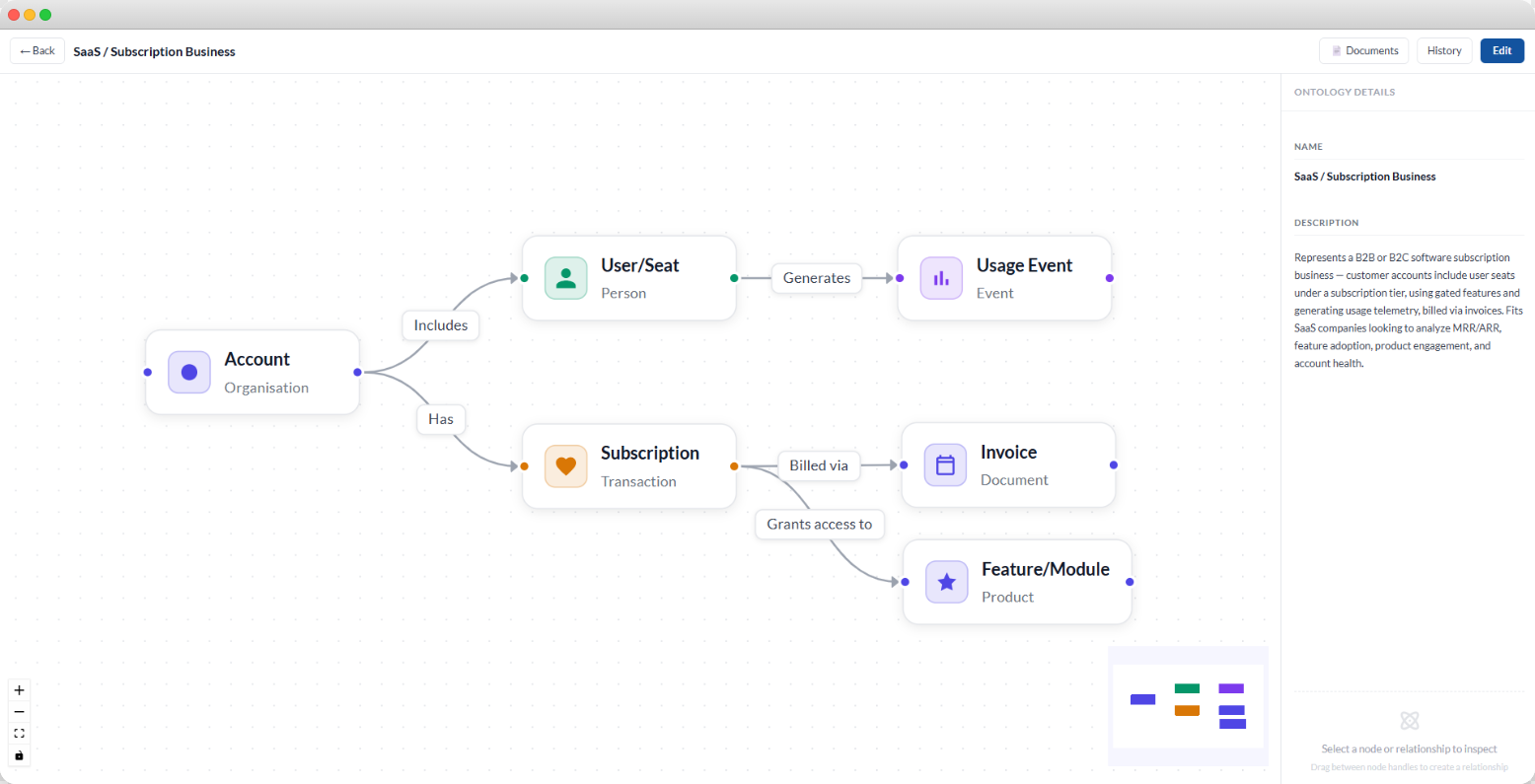
Model the entities and processes that matter in your industry, domain, or department. Assign each entity its semantic-layer data source, then connect the relationships that describe how your business works.
Define the business concepts in your domain—such as Customer, Product, Account, Employee, or Service Request—before assigning their data sources.
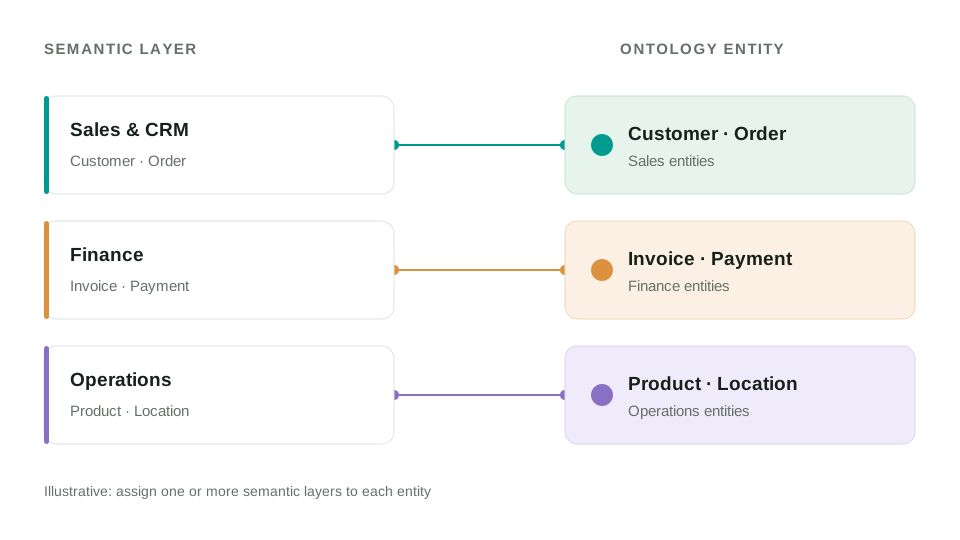
Assign each entity to the semantic layer that provides its data. For example, Customer may use Sales & CRM, Invoice may use Finance, and Product may use Operations.
Describe how entities connect with relationships such as “places,” “includes,” “belongs to,” or “managed by”—even when they use different semantic layers.
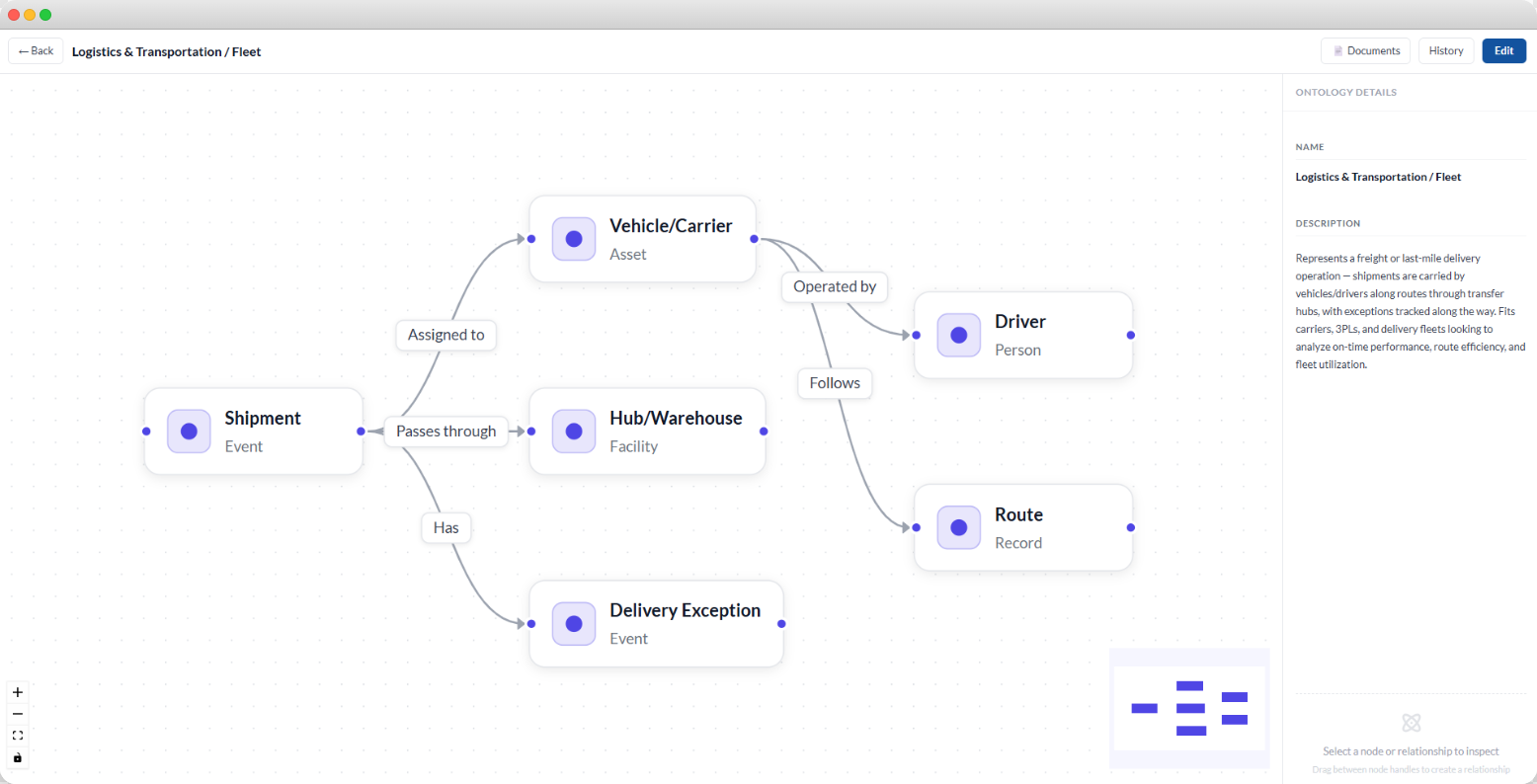
Model relationships that cross teams and departments. A customer may place an order, an order may include products, and an invoice may record its payment. Assign each entity to the semantic layer that provides its data, even when those entities belong to different business domains.
The same entity-first approach adapts to your context—whether you are connecting accounts and claims, patients and appointments, suppliers and purchases, or projects and resources.
In this logistics example, AI starts with delayed shipments, follows their relationships through delivery exceptions, vehicles, drivers, and routes, then identifies a road closure as the likely cause. The animation illustrates how ontology context can guide an investigation across business data.
A connected business model helps people interpret data from multiple semantic layers in context and ask better questions of their analytics.
Present business concepts instead of expecting every user to navigate technical data structures.
Relate information across systems to reflect how work, records, and outcomes fit together.
Give teams a common vocabulary for exploring performance and discussing business results.
Learn how entity-first modeling connects business processes across semantic layers.
A business ontology is a structured model of the concepts, entities, events, and relationships a business cares about. In analytics, it connects those business ideas to the data that represents them.
Yes. In Grafieks, you model the entities first, then assign a semantic-layer data source to each entity. Different entities in the same ontology can use different semantic layers and still be connected through business relationships.
An ontology describes business concepts and how they relate. In Grafieks, users model entities first and assign a semantic layer as the data source for each entity.
Yes. Grafieks Ontology can model entities, processes, and relationships for any industry, business domain, or department. Examples include customers and orders in sales, accounts and invoices in finance, or products and locations in operations.
An ontology gives AI a map of business entities and their relationships. AI can follow relevant paths across entities and semantic layers to investigate a question, trace contributing factors, and highlight insights with meaningful business impact.
See how Grafieks can help model entities and connect processes across your industry, domains, and teams.
Talk to our team ↗